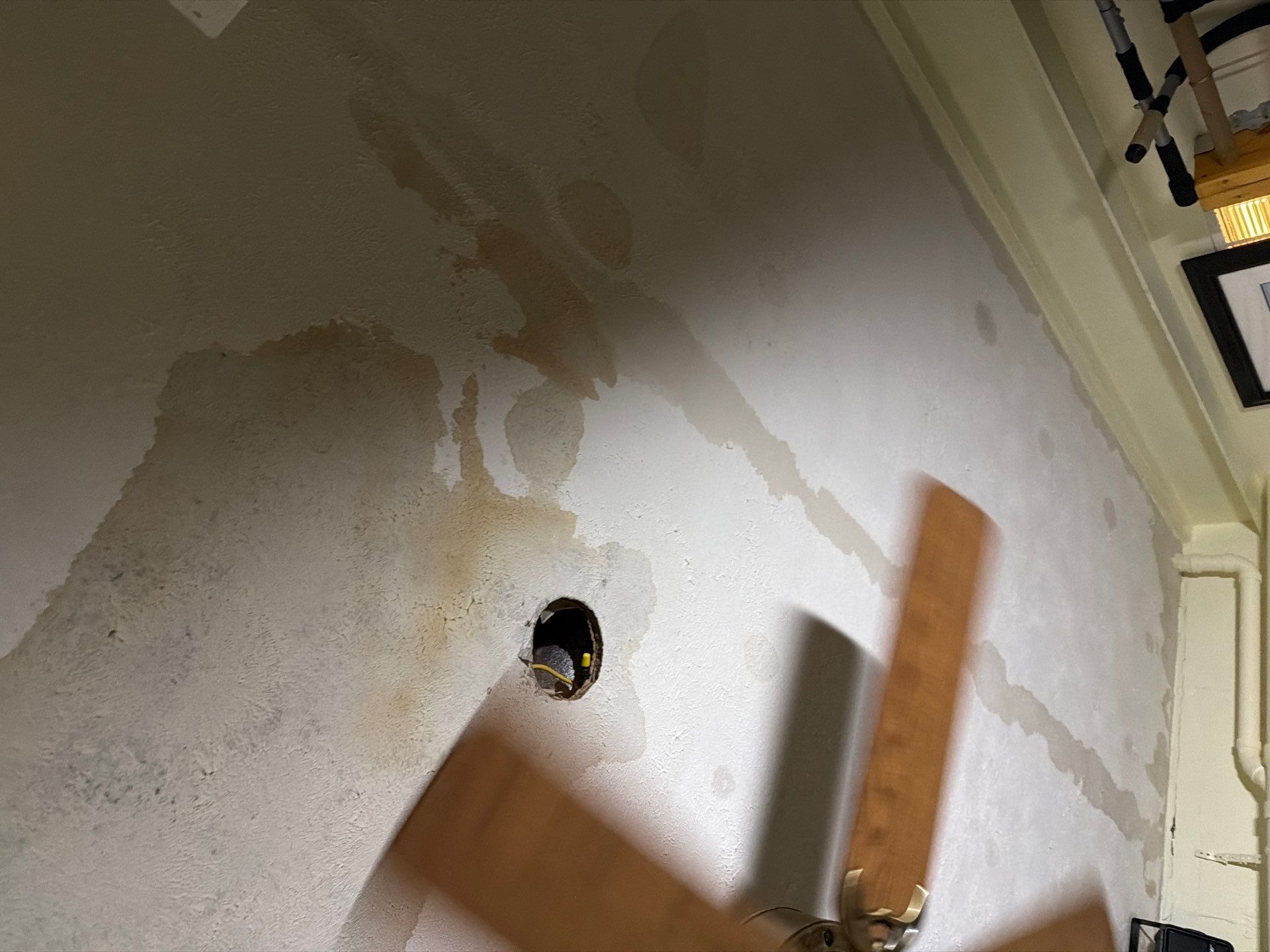
Myth: A Little Water Will Dry on Its Own
The myth says that if the spill looks small and the surface feels damp rather than soaked, fans and an open window will handle it. The reality is that water travels sideways under baseboards, behind cabinets, and into the seam between subfloor and wall plate within minutes. What looks like a two foot puddle on tile often shows a six to eight foot moisture footprint on a meter. Surface evaporation does not solve a wet subfloor, and a wet subfloor at hour one becomes a microbial problem by hour forty eight. The 48 hour rule for mold growth is not a marketing line, it is the timeline we plan against on every job. We have walked into Knightstown kitchens where the homeowner mopped up a dishwasher leak on a Saturday, ran a box fan all weekend, and called us Tuesday because the cabinet kick plate had started to swell. The visible water was gone in an hour. The water inside the cabinet base, under the flooring transition, and wicking up the drywall behind the dishwasher took five days to show itself.
Myth: Shutting the Main Water Off Is Always the First Step
The myth says you should run for the main shutoff before doing anything else. The reality is more nuanced. If the source is a supply line, yes, kill the main. But if the water is coming from a roof leak, a sewer backup, an appliance drain, or a foundation crack during a storm, the main shutoff does nothing. Identify the source first, even if it takes thirty seconds. For storm or groundwater intrusion, the first move is getting people and pets to dry ground and cutting power to the affected area at the breaker. Know where your main shutoff lives before you ever need it. In most Knightstown homes it is in the basement near the front foundation wall, or in a utility closet on a slab build. Tag it, test it twice a year, and make sure every adult in the house can find it in the dark.
Myth: You Should Start Mopping and Wet Vaccing Right Away
The myth says aggressive water removal in the first hour is always good. The reality depends on the water category. Clean supply line water responds well to early extraction with a proper wet vac. Grey water from a dishwasher or washing machine is already contaminated and needs PPE. Black water from a sewer backup or toilet overflow is a biohazard, and mopping it spreads pathogens into grout, baseboards, and your mop bucket. If you cannot identify the category with certainty, stop and call. Our sewage cleanup crews handle Category 3 water with containment and disinfection protocols you cannot replicate with household tools. There is also a time element. Clean water can degrade to Category 2 in roughly twenty four hours, and to Category 3 within forty eight, simply by sitting in contact with dust, drywall paper, and organic debris. The category you start with is not necessarily the category you finish with if response is slow.
Myth: Any Restoration Company Can Show Up Fast and Do the Same Work
The myth treats restoration like a commodity, where whoever answers the phone first is fine. The reality is that response time matters, but so does what happens after the truck arrives. An uncertified crew with a wet vac and three fans is not running the same job as an IICRC certified team with moisture meters, thermal imaging, and properly sized dehumidifiers. We dispatch in most cases within 2 hours across Knightstown, and we publish our approach openly. If you want to compare, read our guide on how to choose a water damage company before you hand anyone your keys.
Myth: Cranking the Heat Speeds Up Drying
The myth says hot air dries faster, so push the thermostat to eighty five and let it rip. The reality is that drying depends on the relationship between temperature, humidity, and airflow, not heat alone. Without dehumidification, raising the temperature in a closed wet space just loads the air with moisture, which then condenses on cool surfaces like windows, exterior walls, and the underside of cabinets. That is how secondary damage starts in rooms that were not even wet to begin with. Proper drying uses calibrated air movers and dehumidifiers sized to the affected square footage. Knightstown Water Restoration technicians calculate the grain depression needed for the space, place equipment based on airflow patterns rather than convenience, and monitor the room daily until materials hit dry standard. A homeowner running three box fans and the furnace is guessing. A calibrated drying chamber is not.
Myth: Insurance Will Not Cover It If You Move Anything
The myth says you must leave everything exactly where it is until the adjuster arrives, or your claim gets denied. The reality is the opposite. Your policy requires you to mitigate further damage. That means moving furniture off wet carpet, lifting rugs, and pulling electronics out of the water. What you should do is document everything with photos and video before you move it. Time stamped images from your phone are the strongest evidence an adjuster will see. Waiting two days for an inspection while your hardwood cups is what gets claims reduced, not reasonable mitigation. Keep receipts for anything you buy in the first hour, from a shop vac rental to a stack of towels. Save the box your damaged electronics came in if you still have it. Write down the time you discovered the loss and the time you shut the source off. Adjusters reward a clear timeline and penalize gaps in the story.
Myth: If the Carpet Feels Dry on Top, the Job Is Done
The myth says the touch test is good enough. The reality is that carpet fibers dry from the top down, and the pad underneath can hold gallons of water while the surface feels fine. Subfloor moisture under the pad commonly reads twenty to thirty percent when the carpet feels dry to bare feet. That hidden moisture is what feeds mold colonies, warps engineered wood from below, and rots the bottom plate of your walls. Verification requires a pin meter or a thermohygrometer reading, not a hand check. A proper dry out ends with a documented final reading on every wet material, compared against an unaffected reference area in the same building. That is the paperwork that closes a claim cleanly and protects you if a buyer or inspector asks about the loss two years from now.